


TV's invasion of viewers' domiciles gets turned upside down in the video as a fan's (Millner) domestic life is superimposed onto the set of Roseanne, driving home unexpected reverberations as the nuclear family teeters on the edge of dysfunction. A schmooze-fest between Millner and Roseanne ends by detonating the UNcommon desire that both fan and star articulate, to GO TOO FAR. Note: This tape is a director’s cut of the version originally telecast as part of the PBS mini-series, Signal to Noise, about the videomaker’s obsession with Roseanne.
Humor
A love letter to the Internet from a feral cat in Brooklyn.
Anonymously published to the web in 2006, Valentine for Perfect Strangers was an early example of an art video that "went viral," amassing over a half-million views and landing on the front page of YouTube.
Vault of Vapors, 2009
One of my weather diary series out in Oklahoma. The tone is wistful, the surroundings wispy (with some puffs of pungency). The TV is on and the porcelain is smeared with some residue atrocity from a previous passion. But all is well as emptiness persists beyond the four walls of this prairie mausoleum.
Vermin of the Vortex, 1996
Alienation in academia beneath the chandeliered opulence of a political correctional facility that caters to clashing cultures with chicken fajitas and carefully worded alphabet soup. Features George at the Flaherty Seminar and the Chicago Underground Film Festival.
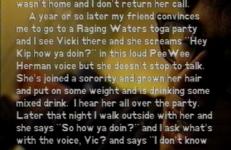
Vicki in 3:30, 1990
Using the fictional character of “Vicki” as a foil, this confessional boy story confronts sexual politics head on.
“(Fulbeck’s) narrative runs around like a chicken with its head cut off, deconstructing everything in its path — dating, gender roles, stereotypes, and the whole notion of sexual conquest. We end up wondering who the ‘winner’ really is” — Keith Fung, Momentum
This title is only available on Kip Fulbeck Selected Videos: Volume Two.
The comings and goings of the late underground filmmaker, Curt McDowell—and the people and activities that came and went along with him—are the themes that run through this existential diary of daily life. McDowell was dying from AIDS-related illnesses during the production of the diary.
“An elegy for McDowell, the videowork captures Kuchar’s mournful remembrances of his long-lasting friendship with the young filmmaker. But it also has the inquisitive charm, perverse humor, and quirky candor that places Kuchar’s visual expressions in a gritty niche all their own.”

Video Valentine, 2022
PASSIONS run deep and LOVE flies high on Cupid’s arrow when ‘Boys’ are the desired target.
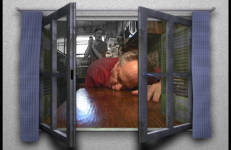
Vintage Visits, 2010
Another edition to my weather diary series, this particular one has more social intercourse occurring in the prairie hovel which houses the hidden longings of he who seeks sustenance from the void. The void acts up in the beginning and then simmers warmly in the glow of companionship from fellow travelers on this Route 66 to who knows where? Perhaps to that pillar of pancake perfection known as Denny's (the restaurant, not the deity).
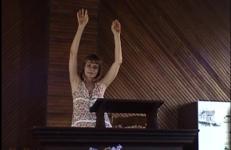
Walt Disney's re-imagineering of Martin Scorsese's classic film Taxi Driver follows Mickey Mouse-obsessed Travis Bickle as he looks for love in a rapidly transforming New York City. A 'fair use' parody by Bryan Boyce.
"A brilliant video essay."
-- Roger Ebert
A trip across the bay to Concord yields a harvest of non-fruit-like beings who celebrate a housewarming that simmers with macho machinations and family discord. The mood is upbeat while the company is lowbrow, and coming out of the bushes rather than the woodwork.

The Waste Land, 1999
A personal interpretation of the poetry and letters of T.S. Eliot that explores the ambiguities of language and space in a scenario built around an anagram. "A brilliant, absurd staging of Eliot’s The Waste Land in the local pub by the master of irony himself, John Smith. Smith’s use of the subjective camera tradition of independent film takes the viewer on a shaky journey from bar to bog and back again."
—UK/Canadian Video Exchange (touring program, 2000)
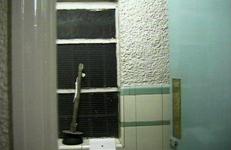
“A spoof on current art attitudes [that] stretches the definition of what can be considered art. Because the late 1960s and early 1970s were periods of innovation, using the human body as art, making process equivalent to product... [etc.], Baldessari questions that very sense of originality and exploration by taking it to its (rather mundane) limits. By taping a stick at one end, then picking it up at the other, he is both questioning and spoofing what constitutes art.” —Marcia Tucker, “John Baldessari: Pursuing the Unpredictable,” John Baldessari (New York: New Museum, 1981)
The Weak Bullet, 1983
A bullet fired by two children travels on and randomly, intervening in a series of scenes in Oursler’s quirky, dismal puppet land. The bullet kills a suicidal man, re-aligns an antenna, strikes a prize stud bull, and ultimately impregnates a woman by passing through her neighbor’s left testicle, then lodging in her ovary. In this metaphor for the spread of violence in society, the bullet represents destructive forces of accidental death and the sexual forces that create new life.
Weather Diary 1, 1986
“The tape ultimately addresses all the big questions — death, origin and family, religion — as well as the small discomforts of the body, only to reverse their order of importance.”
— Margaret Morse, Framework (Los Angeles Contemporary Exhibitions)
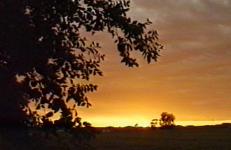
Weather Diary 2, 1987
In a motel in El Reno, Oklahoma, George observes the weather and copes with leaking air conditioning, food shopping, loneliness, television, and eating, among other things.
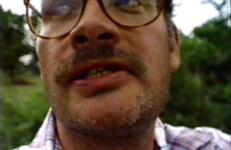
Weather Diary 3, 1988
George goes to Oklahoma, but there's a lull in storm activity. It's spring, and though there's romance in the air, the lightning just doesn’t strike; so George makes his own rain—of sorts. Despite the drought, the videos must go on.
This title is also available on The World of George Kuchar.

Weather Diary 4, 1988
Attempting to apologize for the lack of good weather in Weather Diary 3, George arrives in Milwaukee only to find the drought back in full swing. Since there’s not enough good weather, the tape becomes a social diary against the backdrop of the Motivation Of The Carcasoids project.

Weather Diary 5, 1989
A more socially-active addition to the Weather Diary series, we meet the natives and participate in the rituals of business and schooling and high hopes on the flatlands.
Weather Diary 6, 1990
Scenes from a vacation. Music comes on loud and clear and washes over a series of visual impressions of the land and the sky and the faulty plumbing that submerges porcelain bottoms in a sea of unmentionable froth.
This title is also available on The World of George Kuchar.
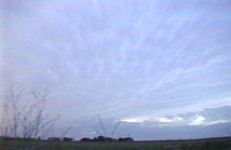
Weather Watch, 1991
A window or two on the outside world is not enough, especially when you have such a lousy view of things as I had in this Oklahoma residential care home. The majesty of the console-model TV gave new dimension to the concept of time and space, and shrank it all down to a 21-inch lump of nature—a 21-incher that didn’t smell and permeate the atmosphere with discomfiture. A meditation on the elsewhere and wanting to be there.
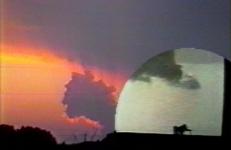
The Web of Dr. Satan, 1989
A non-stop, psychedelic action serial depicting the gnawing bitterness of a UFO debunker as he sinks in a sea of new age imagery and nubile neophytes.
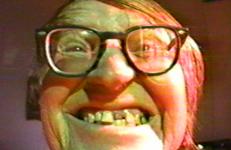
Webtide, 2010
Once again a seaside serenade of sloshing oils and simmering scallops fills the crannies of Cape Cod with dingle-berries of dubious delight! Join a crew of crustacean craving civilians as they shuck their shells of inhibitions to become the truly truculent trespassers of a salty sanctuary. Visit the chefs of chivalry as they skewer the squeamish with talons of titillating tidbits, each one a calorie crunching course in obese obtrusiveness and opulent oddness. Come one, come all, and sample a smorgasbord of simple pleasures in this vacation video of vicarious vacillations.

It was 1990 and, although the iron curtain was falling, Soviet official control was still iron-fisted. Camcorder reporter Skip Blumberg went along with a group of art aficionados on a tour of the Moscow studios of the unofficial artists, an underground community of talented, courageous and often wacky conceptual artists. His report reveals an insider’s view of the art world and, at the same time, is a video about making a video.

Wet Dreams, 1989
Two young women confront careers in a world of violence, lust, and show-business. This student/teacher co-production I made at the San Francisco Art Institute is a colorful collage of digital dementia.
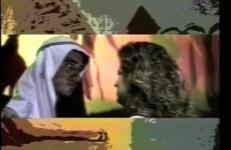
What's That Sound?, 2004
George Barber doffs his cap to the 20th anniversary of Scratch Video with What’s That Sound?, a mesmerizing montage of questions, answers, and the cries and screams of people caught in a disaster movie. The work uses as its starting point, the film Airport '77 where, improbably, a jumbo jet sinks to the bottom of the sea. What follows is a clever amalgamation of absurd linguistics, cries and shouts, highlighting the artist’s permanent fascination with speech, and human reaction to out-of-the-ordinary situations.