


“I could do wonders if I didn't have a body. But the body grabs me, it slows me, it enslaves me.”
-- Ponce de Léon
“I could do wonders if I didn't have a body. But the body grabs me, it slows me, it enslaves me.”
-- Ponce de Léon
“I could do wonders if I didn't have a body. But the body grabs me, it slows me, it enslaves me.”
-- Ponce de Léon
A Prayer For Nettie dramatizes the death of an elderly woman who was Cumming’s photographic model from 1982 to 1993, presenting an improvised series of prayers and memorials for Nettie Harris by people who knew her, and some who did not. In its ambiguous mix of tenderness and aggression, A Prayer For Nettie extends the traditions of the grotesque and the absurd. The fervent prayers of the actors are undermined by indifference, forgetfulness, and the presence of the camera. In the end, comedy turns the tables on piety and remembrance as Nettie looks up from the grave.
Eiko edited this video to illuminate, in fast pace, her solo performance project A Body in Places. The red cloth she often uses in her performance is used as a visual link between different places and communities where Eiko performed.
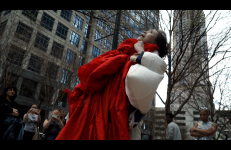
Eiko performed unannounced in the Cathedral of St. John Divine, New York City as an artist in residence in 2016-2018.
Camera by Alexis Moh.
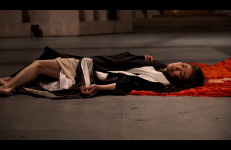
In response to BLM events and to the whole world of injustice, slaughter and abuse... a small comment.
–– Ken Kobland
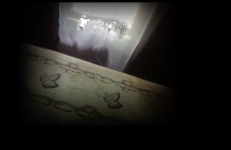
Respite consists of silent black-and-white films shot at Westerbork, a Dutch refugee camp established in 1939 for Jews fleeing Germany. In 1942, after the occupation of Holland, its function was reversed by the Nazis and it became a 'transit camp.' In 1944, the camp commander commissioned a film, shot by a photographer, Rudolph Breslauer.
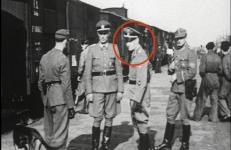
“Nancy Holt’s Revolve, a videotape where the artist, off-camera, interviews her friend Dennis Wheeler who is dying of leukemia, uses his illness and mental reflection as a metaphysical site. Her interview is recorded from the perspective of three video cameras that each capture Wheeler from a different point of view. The three-point perspective was designed to give the illusion of infinity. Holt’s three-camera perspective grips the observer with the reality of the finiteness of death...
Sea In The Blood is a personal documentary about living with illness, tracing the relationship of the artist to thalassemia in his sister Nan, and AIDS in his partner Tim. At the core of the piece are two trips. The first is in 1962, when Richard went from Trinidad to England with Nan to see a famous hematologist interested in her unusual case. The second is in 1977 when Richard and Tim made the counterculture pilgrimage from Europe to Asia. The relationship with Tim blossomed, but Nan died before their return.
Originally part of a larger sculptural installation using prospector's tools, this tape reenacts the search for "Olga," a miner's wife who disappeared on her honeymoon in 1936. As Paul and Marlene Kos call out, "Olga... Olga...", the camera scans the Wyoming wilderness, and their search becomes ritualistic, the repetitive calls building in intensity and breaking down into chanted moans.
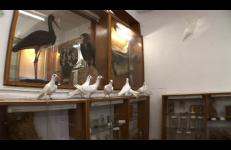
Shot in a local Natural History Museum in northern Israel. 100 white doves fly around cabinets of stuffed birds and other animals. This is a symbol of a culture which is unwilling to let the past go, and lives so naturally with the dead. They stand in silence, but fully present, as we continue living.
Note: This title is intended by the artist to be viewed in High Definition. While DVD format is available to enable accessibility, VDB recommends presentation on Blu-ray or HD digital file.
The Sky Is Falling... is part of an ongoing series of performances that make up The Data Humanization Project.
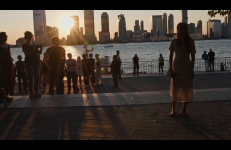
On September 11, 2021, Eiko Otake performed at 7am and 6pm at Belvedere Plaza in Battery Park City by the Hudson River, directly west of where the Twin Towers once stood. This video work is from the 6pm performance.
The first video work created collaboratively with DonChristian Jones as a part of Eiko's The Duet Project: Distance is Malleable. The video was projected as part of The Value of Sanctuary: Building a House Without Walls exhibition at The Cathedral of St. John the Divine in 2019.
Performed by Eiko Otake and DonChristian.
Camera by DonChristian Jones, Inci Eviner, Merián Soto.
Edited by Eiko Otake.
Created during the 2017 Rauschenberg Residency for The Duet Project.
On May 11 2004, Steve Kurtz phoned 911 to report Hope, his wife of 20 years, was unresponsive. When paramedics came to his house, one of them noticed that Kurtz had laboratory equipment, which he used in his art exhibits. The paramedics reported this to police and the FBI sealed off his house.
Authorities later said that Kurtz's wife had died of "heart failure," but he wasn't allowed to return to his home for two days while the FBI confiscated his equipment, and biological samples. They also carted off his books, personal papers and computer.
On May 11 2004, Steve Kurtz phoned 911 to report Hope, his wife of 20 years, was unresponsive. When paramedics came to his house, one of them noticed that Kurtz had laboratory equipment, which he used in his art exhibits. The paramedics reported this to police and the FBI sealed off his house.
Authorities later said that Kurtz's wife had died of "heart failure," but he wasn't allowed to return to his home for two days while the FBI confiscated his equipment, and biological samples. They also carted off his books, personal papers and computer.
Part cloning experiment, part documentary, Stories from the Genome follows an unnamed CEO-geneticist whose company sequenced the Human Genome in 2003 — a genome that secretly was his own. Not satisfied with this feat, the scientist self-replicates, producing a colony of clone-scientists to save himself from Alzheimer’s. The animated video switches between misadventures in cloning, and a history of equally improbable theories of human development.
This title is only available on Soft Science.
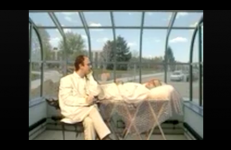
suicide is 70 packed minutes of a fictional filmmaker's crazed ruminations on travel, family history, death and sex as she traverses a world of malls, airports and train stations, chronicling her fiercely hopeful search for a reason to continue living.

A documentary video about the B.I.T. Suicide Box — a motion-triggered camera developed by the Bureau of Inverse Technology (a private information agency), and installed within range of the Golden Gate Bridge to capture a video record of anything that falls from the bridge, and provide an accurate measure of the suicide rate. The piece points to confusing roles for technology within contemporary culture.
— Whitney Biennial (New York: Whitney Museum of American Art, 1996)
Spanish subtitled version also available.
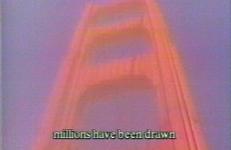
Sylvia is a portrait of the civil rights pioneer Sylvia Rivera for her memorial service in 2002, as told by her chosen family immediately following her death. "A veteran of the 1969 Stonewall uprising, Sylvia was a tireless advocate for all those who have been marginalized as the 'gay rights' movement has mainstreamed. Sylvia fought hard against the exclusion of transgender people from the Sexual Orientation Non-Discrimination Act in New York, and was a loud and persistant voice for the rights of people of color and low-income queers and trans people." --SRLP.org
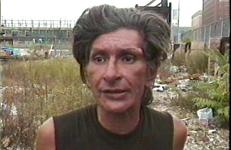
A Tale I Know Nothing About features themes of resurrection, entertainment and death. Inspired by the fantastical Neo-Egyptian Art Deco cinema on Essex Road, London- once a bingo hall, Thomas weaves a visual poem of pigeon-gods, roving eyeballs, and a dead policeman through animated verses of a Dada-esque nonsense rhyme – a mysterious folk memory that has passed through generations of London playgrounds.
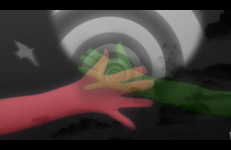
Commissioned by Lower Manhattan Cultural Council (LMCC) for the occasion of Eiko receiving the Sam Miller Performing Arts Award. Premiered at LMCC’s A Toast to Downtown on December 9, 2020. Shot at LMCC’s Arts Center at Governors Island.
Performer Eiko Otake.
Director/Editor Liz Sargent.
DP Minos Papas.
Production by Cyprian Films, New York.
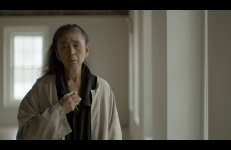
"In The Very Very End, Barber points to his medium's plastic possibility by somehow traveling into the future and the past, nodding to Neville Shute's apocalyptic 1957 novel On The Beach, while setting an end-of-days story in a 21st Century holiday resort.
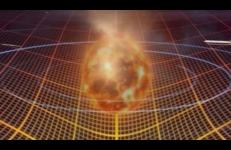
This video was originally an installation at the Whitney Museum of American Art, part of which included the video collaboration Channels of Desire. Recreating coin-operated porno booths, Channels aired one photo image on seven TVs, interrupted only by the viewer inserting a coin and choosing a segment. The concept behind it was the construction of desire in categorical ways, the form of the piece speaking to sexual desire as something that is constantly evading the viewer. The images present women’s experiences with interracial, lesbian, and heterosexual encounters.