


Diary

Karaoke, 1998

An ailing, elderly man listens to a private performance in his room. The singing is a halting mix cross-cultural-Inuktitut and Country & Western. Transgressive and mesmerizing, Karaoke distorts the landscapes of sound and body.

In Inukitut.

This title is also available on Donigan Cumming: Controlled Disturbance and Donigan Cumming Videoworks: Volume 1.
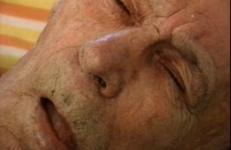
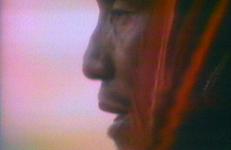
The personal odyssey recorded in The Laughing Alligator combines methods of anthropological research with diaristic essay, mixing objective and subjective vision. Recorded while Downey and his family were living among the Yanomami people of Venezuela, this compelling series of anecdotes tracks his search for an indegenous cultural identity.

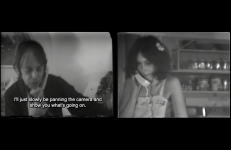
Laurel Klick and I were members of the feminist art program at CalArts and became close lifelong friends. Laurel is behind the camera as I recount my one-sided flirtation with a guy who worked at CalArts in the equipment “cage” - the cage where I checked out the video Portapak - the Portapak we utilized to record my anecdote. My story about an everyday interaction would become a trademark of my work. “Laurel and Susan” was not edited or presented publicly until 2022.

Sections 1-30 of an incomplete extended poem describing the artist's connection to the radical black tradition. The completed poem will be formed of 180 sections.

"Lessons are all about constraints; they are thirty seconds, must feature a black figure, and I have rules about where to make cuts, how to edit sound, etc."
— Martine Syms in conversation with Aram Moshayedi, Mousse Magazine

Letters, conversations: New York-Chicago, Fall, 2001 is driven by a fragmented voice-over that criss-crosses between two female voices – one seemingly formal and distant, the other more conversational and intimate. It begins with short excerpts from emails, phone conversations and letters between friends, family, ex-lovers and acquaintances in the days and weeks following September 11th, 2001.

"It was as if I was living by the Nike slogan Just Do It."
— George Barber

Wendy Clarke continues her ongoing project Love Tapes, in which speakers sit in front of a camera and talk for three minutes about their thoughts on love. The videos here were recorded at Losing the Plot Film Festival in Hexam, United Kingdom in July of 2024.

Nine individuals visit the Santa Monica Mall and share their thoughts and feelings about love with Wendy Clarke and her camera. Love Tapes: Santa Monica Mall is part of Clarke's ongoing project, Love Tapes.

The Love Tapes: World Trade Center is a collection of videos from Wendy Clarke's Love Tapes project. The project began in 1977 and is ongoing. Love, as described throughout the tapes, is not defined by any one singular meaning, but is instead contextualized by the variety of personal perspectives and experiences within this collection. Videos in this selection were recorded at a station the artist set up in the World Trade Center in 1980, open over the course of three weeks.

LYNDALE, 2018

LYNDALE is a story of shifting family dynamics, told through the relationship of two brothers. Shot on ten different video formats, this experimental documentary is both the story of a Chicago family, and a record of the digital revolution in the early 2000s. The piece takes place over a six-year period during which filmmakers Oli Rodriguez and Victoria Stob shared a house with Rodriguez’s brother, Jeff.

LYNDALE, 2018

LYNDALE is a story of shifting family dynamics, told through the relationship of two brothers. Shot on ten different video formats, this experimental documentary is both the story of a Chicago family, and a record of the digital revolution in the early 2000s. The piece takes place over a six-year period during which filmmakers Oli Rodriguez and Victoria Stob shared a house with Rodriguez’s brother, Jeff.

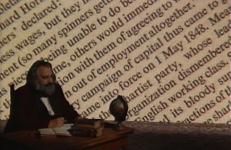
Kipnis describes this tape as "an appropriation of the aesthetics of both late capitalism and early Soviet cinema—MTV meets Eisenstein—reconstructing Karl Marx for the video age.” She presents a postmodern lecture delivered by a chorus of drag queens on the unexpected corelations between Marx’s theories and the carbuncles that plagued the body of the rotund thinker for over thirty years. Marx’s erupting, diseased body is juxtaposed with the “body politic", and posited as a symbol of contemporary society proceeding the failed revolutions of the late 1960s.

Memory Palace is a short video grounded in the personal history of the artist. A discovery of a photo album activates memories of physical spaces, which in turn open doors to reminiscences of past family life. Inspired by the classical method of loci, the film presents a woman — singer/songwriter Alice Smith — at work in Los Angeles.

Wendy Clarke's videos frequently feature unscripted dialogue, inviting speakers to create a video diary or to share their thoughts on a topic, such as love. This approach often results in sincere and honest portraits of the speakers. In Mother and Daughter Soap Opera, Wendy focuses her video diary on her relationship with her mother, Shirley Clarke. Both women set up a camera at their respective homes and recorded their end of a phone conversation between them: Wendy in New York City and Shirley in Los Angeles at the time.

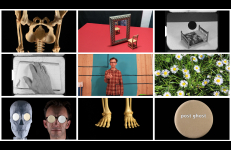
A newsletter meets home movie, made by an experimental filmmaker who was constructing a paper mâché skeleton but whose leg (the filmmaker’s) suddenly went wrong. It got fixed, but (spoiler alert) that’s just kind of incidental. 

Possibly a diary but probably not a documentary: this is a play with form, animated with glee, edited with joy.

In a version of the “teenage diary,” Benning places her feelings of confusion and depression alongside grisly tales from tabloid headlines and brutal events in her neighborhood. The difficulty of finding a positive identity for oneself in a world filled with violence is starkly revealed by Benning’s youthful but already despairing voice.

This title is also available on Sadie Benning Videoworks: Volume 1.
A nocturnal COVID-19 memoir. 

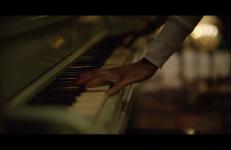
Piano assemblage and image sequencing by Bob Snyder. Images by Sara Livingston.

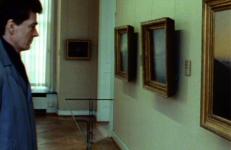
"Persistence was shot in 1991-92 in Berlin, and edited with films by U.S. Signal Corps cameramen in 1945-46, obtained from Department of Defense archives. Interspersed through these materials are filmic quotations from Rossellini's Germany Year Zero (1946). A meditation on the time just after a great historical event, about what is common to moments such as these—the continuous and discontinuous threads of history—and our attachment to cinematic modes of observation that, by necessity, shape our view of events.

A Prayer For Nettie dramatizes the death of an elderly woman who was Cumming’s photographic model from 1982 to 1993, presenting an improvised series of prayers and memorials for Nettie Harris by people who knew her, and some who did not. In its ambiguous mix of tenderness and aggression, A Prayer For Nettie extends the traditions of the grotesque and the absurd. The fervent prayers of the actors are undermined by indifference, forgetfulness, and the presence of the camera. In the end, comedy turns the tables on piety and remembrance as Nettie looks up from the grave.

Susan Mogul's first video diary work, produced two years before Everyday Echo Street: A Summer Diary (1993), follows the artist on a trip though Eastern Europe immediately after the fall of the USSR. Through discussions with various characters about politics, art, and each others personal lives, Mogul creates a video time capsule of social life in Poland, then Czechoslovakia, and former Yugoslavia.

In Shayne's Rectangle, Dani Leventhal's moving and mysterious prayer for healing, a horse farm and a casual poolside dissection are the nodes between which a series of patiently taken sharp turns maneuver through moods both intimate and detached. The camera pursues, observes, offers, reflects, and is reflected. Things clear and things indistinct interact rhythmically, resonantly, producing a volatile and haunting visual prosody.

— Jeremy Hoevenaar

Ireland, October 20th 2007

The filmmaker returns to the city where he made the first video in the series and looks back at the events of the past six years.

Six Years Later is the eighth episode in the Hotel Diaries series, a collection of video recordings made in the world’s hotel rooms, which relate personal experiences and reflections to contemporary conflicts in the Middle East.

Skim Milk & Soft Wax explores Jewish identity from the point of view of the American filmmaker, who was raised to believe that Israel is the "land of milk and honey". However, the realities of her personal experiences of Israel collide with that Edenic image. Instead, the state of Israel is complex, shape shifting, and often disappointing. Therefore: skim milk — a substance of reduced nutritional value, but which still lives in the name of "milk". And wax, the stuff of religious offerings, which is always ready to change its shape.

John Smith, throughout his 40-year career, has approached the moving image from film, video and installations, generating a tremendous body of work that’s as diverse in its topics as it is in its methods. Weaving between early structuralist film and more personal, diaristic, documentary approaches to the places in which he lived, most notably London, his output is both broad and varied.

“Christopher Wilcha’s fascinating feature-length video reminds us how seldom we’re allowed to see certain businesses operating from the inside. Wilcha, a 22-year-old college graduate and alternative-rock enthusiast, was hired by the Columbia Record and Tape Club—apparently as a fluke—to help launch a whole new niche-marketing division, which brought him face-to-face with the contradictory meanings of the term ‘alternative’ once it’s been embraced by the mass market.