


Expedition/Travel

In 1971 the curator Allon Schoerner was commissioned by Hadassah, a Jewish women’s organization, to create an exhibition about Jerusalem for the Jewish Museum in New York City.  As part of this endeavor, three artists were sent overseas to document the city: David Cort of the Videofreex, young media artist Shalom Gorewitz, and photographer and light show artist Bob Quinn.

This five-DVD set compiles all the raw footage shot on this journey. 
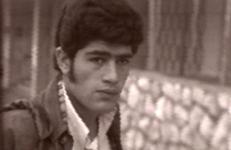
David Cort of the Videofreex travels to Jerusalem. This tape contains raw footage of him as he is taken on a tour through a poor neighborhood by a group of young men. There is talk of the Israeli Black Panther Party, and of drug dealers and poverty. Somebody says the tape is being made for the Jewish Museum in NYC. The Israeli guide talks about the movement, and says the bourgeois and the poor can meet through parties and drugs. They visit a woman and her children who are living in poverty, and interview her about the needs of her family.

Just a Soul Responding is a four-channel synchronized video installation. A composite of the four channels presented in one video is available from Video Data Bank for educational use only. 

An experimental documentary about resistance, balance and fame. Kings of the Sky follows tightrope artist Adil Hoxur as he and his troupe tour China’s Taklamakan desert amongst the Uyghurs, a Turkic Muslim people seeking religious and political autonomy.

The Kiss, 1999

Made with Ian Bourn.

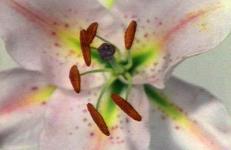
A depiction of the forced development of a hothouse flower. Organic growth is progressively overtaken by a more sinister mechanical process.

"The makers manage very convincingly to wrong-foot the viewer in just five minutes in this minimalist, lyrical film about a blossoming flower."

—International Film Festival Rotterdam (2000)

"A film of a disarming seeming simplicity which enigmatically prompts reflections on its meaning and its use of media."

Kuyenda N’kubvina looks at how thought and culture propagate in the slender nation of Malawi. Weaving our way through video halls, book stores, dance floors and radio stations, in cities and small villages, we meet Malawians who traffic in ideas, reflecting the rhythms of Malawian contemporary life. The video was instigated by the filmmaker’s relative ignorance about the people and culture of southeast Africa, and accompanies her as she seeks out individuals and infrastructures that channel and articulate Malawian identity.

A woman survives a clinical death in 1988 and wakes up hearing voices in her head. Samuel, a spirit, has started to speak through her. People identify her as a medium. Samuel proclaims a mission to save the world before the year 2012. The entity's name soon changes from Samuel to EN K1, a Sumerian God who claims to be the father of the human race.

...a "mordantly nostalgic" sojourn across America. A landscape of mute streets, empty rooms and serene fields; the remains of a civilization which has momentarily disappeared.

–– Ken Kobland

This work was restored and revised in 2022. 

The personal odyssey recorded in The Laughing Alligator combines methods of anthropological research with diaristic essay, mixing objective and subjective vision. Recorded while Downey and his family were living among the Yanomami people of Venezuela, this compelling series of anecdotes tracks his search for an indegenous cultural identity.

A collaboration with writer Luc Sante made in Tangier, Morocco, a city where neither of us had ever been. En route from the airport to the city center, we found ourselves amazed by the landscape outside of the car windows; a massive construction project under way in all directions. While not in itself unusual, we were by struck dumb by the epic scale and seemingly incomprehensible plan of the development and were drawn to return together to this puzzling zone.

-- Jem Cohen

"Let Each One Go Where He May is the stunning feature debut of celebrated Chicago-based filmmaker Ben Russell. Having its world premiere in Toronto, the film traces the extensive journey of two unidentified brothers who venture from the outskirts of Paramaribo, Suriname, on land and through rapids, past a Maroon village on the Upper Suriname River, tracing the voyage undertaken by their ancestors, who escaped from slavery at the hands of the Dutch 300 years prior.

Litau, 2007

A tapestry of images and sounds. Tango dancing. A conversation about heaven and hell, with illustrations. Horses nuzzle. A woman reclines. Silent soccer. Street entertainers play classical music. Travel is mysterious and sometimes fraught.

Despite assurances from local municipalities, a fact of life is that Manholes blow sky high more frequently than most people realize. Manhole 452 directs the viewer’s attention to the shapes, sizes and patterns of manhole covers on Geary Street in San Francisco, and then plunges deep below into the manholes themselves to explore the hidden threat that lies below.

Despite assurances from local municipalities, a fact of life is that Manholes blow sky high more frequently than most people realize. Manhole 452 directs the viewer’s attention to the shapes, sizes and patterns of manhole covers on Geary Street in San Francisco, and then plunges deep below into the manholes themselves to explore the hidden threat that lies below.

Using the opening of Godard's film Alphaville as a foundation, Lord constructs a vision of the evolving global city during the last years of the 20th Century. Structured as a series of repetitions, the montage of the changing city is offset by shots of corporate Silicon Valley facades. The result is a dialectical contrast between urban and suburban space, body and mind, chaos and order, and the postmodern and the modern. Shot in Hi-8 video in Tokyo, Fukuoka City, Mexico City, Rome, San Francisco, Naples, and Los Angeles.

Jacqueline Goss and Jenny Perlin retrace the journey of two 18th-century astronomers tasked with determining the true length of the meter. From the Mediterranean Sea to the English Channel, The Measures explores the metric system’s origins during the violence and upheavals of the French Revolution. Along the way, Goss and Perlin consider the intertwining of political and personal turmoil, the failures of standardization, and the subtleties of collaboration.

Jacqueline Goss and Jenny Perlin retrace the journey of two 18th-century astronomers tasked with determining the true length of the meter. From the Mediterranean Sea to the English Channel, The Measures explores the metric system’s origins during the violence and upheavals of the French Revolution. Along the way, Goss and Perlin consider the intertwining of political and personal turmoil, the failures of standardization, and the subtleties of collaboration.

Chief Waiwai recounts for his village the story of a trip he and a small entourage made to meet the Zo’é, a recently contacted group whom the Waiãpi “know” through video. Both groups speak Tupi dialects and share many cultural traditions, but the Zo’é are currently experiencing the phenomena of contact that the Waiãpi underwent 20 years ago. Waiãpi cameraman Kasiripinã illustrates the Waiwai’s account of the trip with video. The Zo’é afford their visitors the chance to re-encounter the way of life and wisdom of their ancestors.

Chief Waiwai recounts for his village the story of a trip he and a small entourage made to meet the Zo’é, a recently contacted group whom the Waiãpi “know” through video. Both groups speak Tupi dialects and share many cultural traditions, but the Zo’é are currently experiencing the phenomena of contact that the Waiãpi underwent 20 years ago. Waiãpi cameraman Kasiripinã illustrates the Waiwai’s account of the trip with video. The Zo’é afford their visitors the chance to re-encounter the way of life and wisdom of their ancestors.

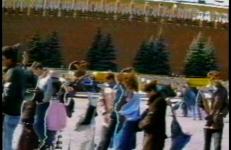
In this video diary of Breder’s trip, the viewer is given an after-hours tour of the Soviet capital. The different segments include a daylight panorama of Red Square, a scene in which Breder is handed the phone by his Russian artist hosts, a walking tour precursor of My Body Sees You, an underground performance with gas flames in a glass column, the midnight changing of the guard at Red Square, and a hypnosis session with a psychic that ends with a close up of another Russian magician on television.

Motorist, 1989

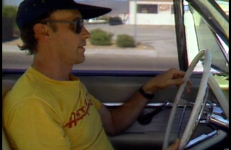
Since his early days in Ant Farm, Lord’s evocation of the automobile has been the car as avatar, as the spirit of America—that consummate combination of superior organized corporate technology and the pioneering triumph of the willful individual driver. Motorist is a 69-minute road picture in which the camera rides shotgun with TV actor Richard Marcus as he plays a drifting driver.

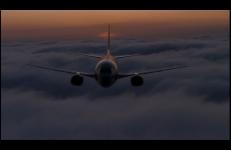
Moving Stories strings together scenes of passenger aircraft in flight.  In this short study of the dramatic and narrative power of image and sound, Provost manipulates cinema language and reaches, though minimal means, a strong, emotionally loaded result.  With a limited number of images, an absorbing soundtrack, and a suggestive story line, the viewer's imagination is stimulated to the maximum.

Made in Germany, October 14th, 2004

While the Iraq war continues, a day's sightseeing and the features of a German hotel provoke a stream of thoughts about events large and small.

Museum Piece is the second episode in the Hotel Diaries series, a collection of video recordings made in the world's hotel rooms, which relate personal experiences and reflections to contemporary conflicts in the Middle East.

This piece purports to be about the discontinuation of the much-loved format, Kodachrome, and with it the further endangerment of super-8 film. But it has other agendas of reclamation and personal reckoning that are its true subject matter.

Diary of time spent in Oaxaca, Mexico over several years.